20 Provençal French Phrases To Add To Your Vocabulary
Provence is perhaps most famous for its magnificent landscapes, but there is another unique feature of the region: Provençal French words and expressions that are particularly unusual. Words which, just like that, make the cicadas hum and the ice cubes clink in the pastis glass. Expressions that evoke bouillabaisse, thyme and lavender.
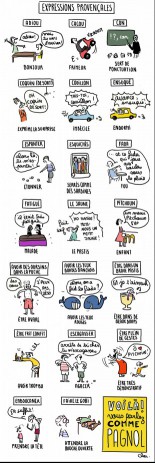
These Provençal French expressions are the ones you find in the books by Marcel Pagnol or at the Vieux-Port in Marseille, which you can only say avé l’accent (with the accent)! We’ve compiled the best ones, to help make your vacation last just a bit longer. We’ll go beyond dégun (no one) and peuchère (poor thing): These Provençal expressions will really espanter (surprise) you, especially if you’ve decided to visit Provence this summer! If you want a Provençal French to Parisian French translation guide, you can also scroll to the bottom to see our infographic that breaks it down.
Visit Provence With 20 Provençal French Expressions
Adiou
Definition: Literally ”goodbye,” but it’s also used to say hello, because Provençal has that contrarian spirit
Cacou
Definition: Poser, blowhard
Example Sentence: Ô Marius, arrête un peu de faire le cacou ! (“Oh Marius, stop being such a poser!”)
Con
Definition: Used like punctuation at the end of a sentence
Example Sentence: Hier j’ai mangé une bonne bouillabaisse con (“Yesterday I ate a nice bouillabaisse con”)
Coquin (de sort)
Definition: Interjection expressing surprise or dismay
Example Sentence: Ô coquin de sort, mon fils part vivre à Paris. (“Oh coquin de sort, my son has left to live in Paris.”)
Couillon
Definition: Imbecile
Example Sentence: Quand on fera danser les couillons, tu ne seras pas à l’orchestre. (“When they make the imbeciles dance, you won’t be in the orchestra.”) [From Marius by Marcel Pagnol]
Ensuqué
Definition: Drowsy from heat, asleep
Example Sentence: Regarde-le, l’autre ensuqué dans sa voiture ! (“Look at him, the other one asleep in his car!”)
Espanter
Definition: To surprise
Example Sentence: Alors ça, ça m’espante. (“Well, that surprises me.”)
Esquichés
Definition Packed like sardines
Example Sentence: Regarde-moi tous ces fadas esquichés dans le petit train des touristes. (“Look at all those crazy people packed like sardines in the little tourist train.”)
Fada
Definition Literally “crazy,” also used as punctuation at the end of a sentence, like Ô fada !
Example Sentence Il est fada celui-là, il veut jouer aux boules sous la pluie (“He’s crazy, he wants to play bocci in the rain”)
Fatigué
Definition: Someone from Marseille is never ill, they’re just très fatigué (very tired)
Example Sentence: Marius, il est souvent fatigué : il passe sa vie chez le docteur. (“Marius is often tired (ill): He spends his life at the doctor.”)
Le jaune, le pastaga
Definition: Pastis (an anise-flavored spirit)
Example Sentence: Ô Marius, mets-nous un jaune, y fait soif. (“Oh Marius, pour us a pastis, we’re thirsty.”)
Pitchoun
Definition: Child
Example Sentence: Ce pitchoun, il tient de son fada de père. (“This child, he takes after his crazy father.”)
Avoir des oursins dans la poche
Definition: To be stingy
Example Sentence: Alors Marius, t’as des oursins dans la poche ou quoi ? Sers-nous donc un petit pastaga ! (“So Marius, are you stingy or what? Serve us a little pastis!”)
Avoir les yeux bordés d’anchois
Definition: To have red eyes because of tiredness
Example Sentence: Toi, on dirait bien que t’as fait la fiesta : t’as les yeux bordés d’anchois. (“It really looks like you partied: Your eyes are red.”)
Être dans un brave pastis
Definition: A Provençal expression that means being in a sticky situation
Example Sentence: Té Marius, nous voilà dans un brave pastis. (“Well Marius, here we are in a sticky situation.”)
Être frit confit
Definition: To be drunk
Example Sentence: Ô Fada ! Je suis frit confit ! (“Oh wow! I’m drunk!”)
Escagasser
Definition: To annoy, tire
Example Sentence: Ces cigales m’escagassent. (“These cicadas are annoying me.”)
Être plein de gestes
Definition: To gesture a lot
Example Sentence: La femme de Marius, à chaque fois que je la vois, elle est pleine de gestes. (“Marius’s wife, every time I see her, she gestures a lot.”)
Emboucaner
Definition: To annoy
Example Sentence: Arrête de m’emboucaner ou je te prive de pastis. (“Stop annoying me or I won’t give you any pastis.”)
Faire le gobi
Definition: To wait with your mouth open (like a gobi fish)
Example Sentence: Arrête un peu de faire le gobi et viens m’aider. (“Stop standing there with your mouth open and come help me.”)
Translation Provençal French To Standard French
This article was originally published on the French edition of Babbel Magazine.
Comments on "20 Provençal French Phrases To Add To Your Vocabulary" :
Leave a Reply
RECOMMENDED NEWS
Linguistic Halloween: The Origins Of The Season’s Spookiest Words
Halloween is a huge day in a child’s life. It’s the only holiday where it’s perfectly alright ...
Shop Now
The Top 5 Reasons To Learn Norwegian
Admittedly, the case for learning Norwegian is hardly a numbers game. Norway is the only country whe...
Shop Now
What Are Grammatical Tenses And Aspects?
Time can easily be divided into three parts: the past, the present and the future. You can slot ever...
Shop Now
How To Say Goodbye In Norwegian
What goes up must come down, and what starts with “hello” must eventually end with ̶...
Shop Now
What Is The Longest Word In The World?
You may have heard that the longest word in the world is antidisestablishmentarianism. This 28-lette...
Shop Now
How I Went About Learning A Language From Scratch
Is there anything more daunting than learning a language from scratch? Libra here, the most indecisi...
Shop Now